Slow Cooker Pot Roast: Hearty and Tender
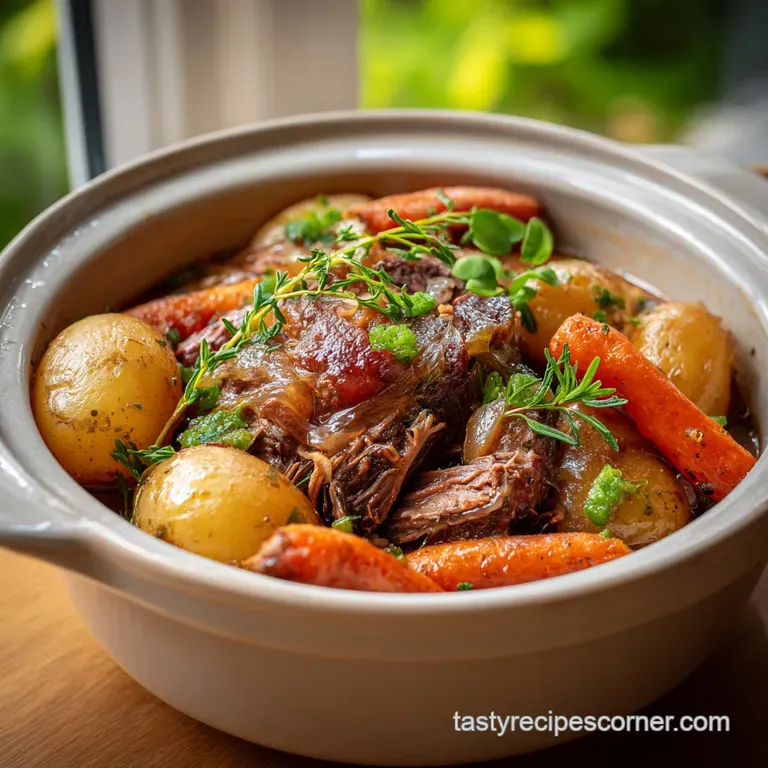
- Time: Active 20 minutes, Passive 8 hours, Total 8 hours 20 mins
- Flavor/Texture Hook: Fork tender beef with velvety mahogany gravy
- Perfect for: Lazy Sunday family dinners or hands off meal prep
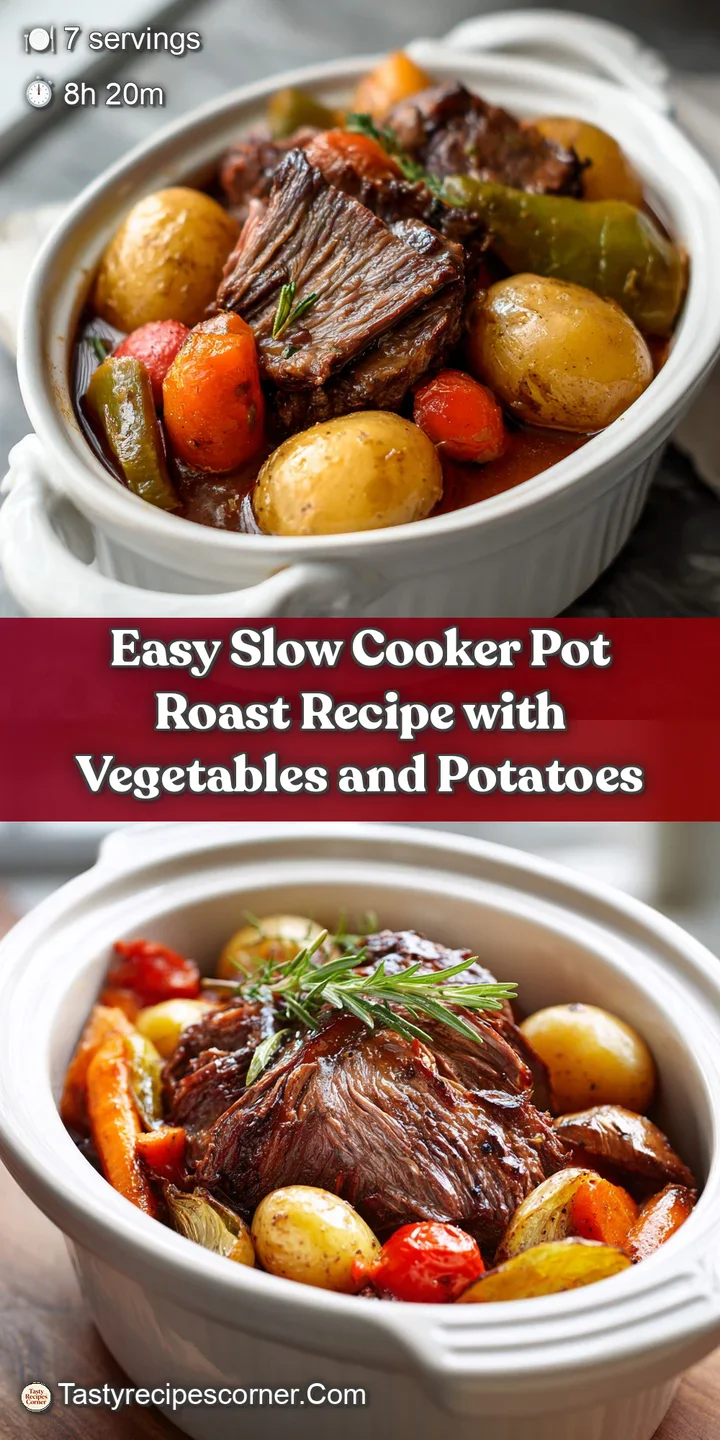
- Easy Slow Cooker Pot Roast Recipe with Vegetables and Potatoes
- Hearty Soul Warming Sunday Night Comfort
- Authoritative Timing and Nutrition Breakdown
- Selecting the Best Pot Roast Components
- Essential Tools for Tender Beef Success
- Mastering the Flavor Layering Process
- Solving Common Slow Cooker Mistakes
- Troubleshooting Common Issues
- Scaling for Large Groups or Couples
- Creative Twists on Classic Roast Flavors
- Proper Storage and Zero Waste Ideas
- The Best Southern Side Dish Pairings
- Southern Kitchen Myths
- Recipe FAQs
- 📝 Recipe Card
Easy Slow Cooker Pot Roast Recipe with Vegetables and Potatoes
The air in a Tennessee kitchen on a Sunday afternoon has a very specific weight to it. It’s heavy with the scent of searing beef, sharp onions, and the sweet, woody aroma of fresh thyme. Growing up, the "Sunday Roast" wasn't just a meal; it was a promise.
It was the centerpiece that waited patiently in the crock on the counter while we were out, working its magic until the very moment we walked through the door and were hit by that intoxicating, savory cloud of steam.
Discover our simple yet incredible slow cooker pot roast recipe, complete with tender vegetables and potatoes.
This isn't one of those watery, bland roasts you might have encountered at a lackluster buffet. We are talking about a dish where the beef has surrendered every bit of its toughness to become something almost butter like.
The potatoes don't just sit there; they soak up the beef bone broth and the tang of balsamic vinegar until they are flavor bombs in their own right. If you’ve ever struggled with meat that came out dry or vegetables that turned into a sad mush, I’ve got you.
We are going to build this meal in layers, ensuring every bite feels like a warm hug for your soul.
I remember the first time I tried to make this without searing the meat. I thought I could save ten minutes and a dirty pan. Honestly, don't even bother if you're going to skip the sear. That deep brown crust is where the soul of the dish lives. Without it, you’re just boiling meat.
We’re going to walk through how to treat that 3.5 lb chuck roast with the respect it deserves, using a heavy cast iron skillet to create a crust that will eventually dissolve into the most decadent gravy you’ve ever tasted. Let's get into the "why" behind the magic.
Hearty Soul Warming Sunday Night Comfort
The Low and Slow Magic: When we cook a tough cut like chuck roast at a low temperature for 8 hours, we aren't just heating it up. We are physically transforming the connective tissue.
That tough white collagen slowly melts into gelatin, which coats the muscle fibers and gives the meat that luscious, melt in-the mouth feel that lean cuts simply cannot achieve.
Building the Foundation: Placing the onions and garlic at the bottom serves a dual purpose. First, it acts as a natural roasting rack, lifting the beef so it doesn't just sit in a puddle.
Second, it puts the aromatics in direct contact with the hottest part of the slow cooker, allowing their natural sugars to caramelize and infuse the entire braising liquid from the bottom up.
Acid for Balance: The combination of Worcestershire sauce and balsamic vinegar provides the necessary "bright" notes to cut through the heavy fat of the beef. Without that splash of acid, the dish can feel one dimensional.
The balsamic, in particular, adds a hidden sweetness that rounds out the savory beef bone broth perfectly.
| Thickness of Roast | Internal Temp for Shredding | Rest Time | Visual Cue |
|---|---|---|---|
| 2 inches | 200°F - 205°F | 15 minutes | Meat pulls apart with zero resistance |
| 3 inches | 200°F - 205°F | 20 minutes | Fat is translucent and jiggly |
| 4 inches | 205°F | 20 minutes | Bone (if present) slides out clean |
Choosing the right cut of meat is the biggest decision you'll make today. A 3.5 lb chuck roast is the gold standard because it’s marbled with enough fat to stay juicy over a long 8 hours cook time.
If you try to use a leaner cut like a round roast, you'll end up with something that feels like chewing on a wool sweater. We want that fat; it's our insurance policy against dryness.
Authoritative Timing and Nutrition Breakdown
When we talk about "8 hours on Low," it’s not just a suggestion. It’s a biological requirement for the beef. If you try to rush it on High for 4 hours, the meat will be "cooked," but it won't be "tender." There is a massive difference.
The 8 hour mark is where the fibers finally give up their grip and relax. If you're using a smaller 2 lb roast, you might think you can cut the time in half, but you still need at least 6 hours to get that specific texture we’re chasing.
| Component | Science Role | Pro Secret |
|---|---|---|
| Chuck Roast | High collagen content | Always pat it bone dry before searing for the best crust |
| Yukon Gold Potatoes | Medium starch level | Keep the skins on; they hold the potato together during the long braise |
| Beef Bone Broth | Rich protein base | Use bone broth over standard stock for a silkier, more body rich gravy |
| Balsamic Vinegar | Acidic catalyst | It tenderizes the outer fibers while adding a subtle fruitiness |
Adding the cornstarch slurry at the very end is the final touch that turns a "pot roast" into a "masterpiece." By whisking 2 tbsp of cornstarch with cold water and stirring it into the boiling juices, you create an emulsion that clings to the meat and vegetables.
It transforms the liquid from a thin soup into a velvety sauce that coats the back of a spoon.
Selecting the Best Pot Roast Components
- 3.5 lb beef chuck roast: Look for "Choice" or "Prime" grade with plenty of white flecks of fat (marbling).
- Substitute: Brisket (point cut). Why this? Both have high connective tissue that melts beautifully during long, slow cooking sessions.
- 1.5 lbs Yukon Gold potatoes: These stay creamy without falling apart like Russets do.
- Substitute: Red bliss potatoes. Why this? Waxy texture ensures they hold their shape even after 8 hours of heat.
- 1 lb carrots: Large chunks are better than baby carrots.
- Substitute: Parsnips. Why this? They offer a similar bite but with a more peppery, complex sweetness.
- 1.5 cups beef bone broth: This is the flavorful liquid gold that powers the dish.
- Substitute: Beef stock with 1 tsp unflavored gelatin. Why this? Mimics the mouthfeel of homemade bone broth if you're using store-bought stock.
- 5 cloves garlic: Smashed to release their oils.
- Substitute: 1 tsp garlic powder. Why this? Good in a pinch, though it lacks the toasted depth of fresh cloves.
- 2 sprigs fresh rosemary & thyme: The aromatic backbone.
- Substitute: 1 tsp each dried herbs. Why this? Use half the amount if dried, as they are more concentrated and potent.
Essential Tools for Tender Beef Success
You don't need a kitchen full of gadgets, but a few specific items will make your life much easier. First and foremost, a 6 quart slow cooker is the ideal size for this recipe. If your slow cooker is too large, the liquid will evaporate too quickly; if it’s too small, the roast won't be submerged enough to braise properly.
I personally use a Crock Pot with a locking lid for easy transport, but any reliable brand will do.
A heavy cast iron skillet, like a Lodge, is your best friend for the searing phase. Cast iron holds heat better than stainless steel, which means when you drop that cold 3.5 lb roast into the pan, the temperature won't plummet. You want a constant, fierce heat to create that mahogany crust. If you're looking for a lighter alternative for other meals, check out my Juicy Chicken Pot Roast for a bird that benefits from a similar slow braising technique.
Finally, invest in a pair of sturdy tongs and a fat separator. Sifting through 8 hours of beef juices to find the herbs and garlic is much easier with the right tools.
The fat separator is a game changer for the gravy; it allows you to pour off the flavorful juices while leaving the heavy grease behind. This ensures your final sauce is rich and savory, not oily and heavy on the stomach.
Mastering the Flavor Layering Process
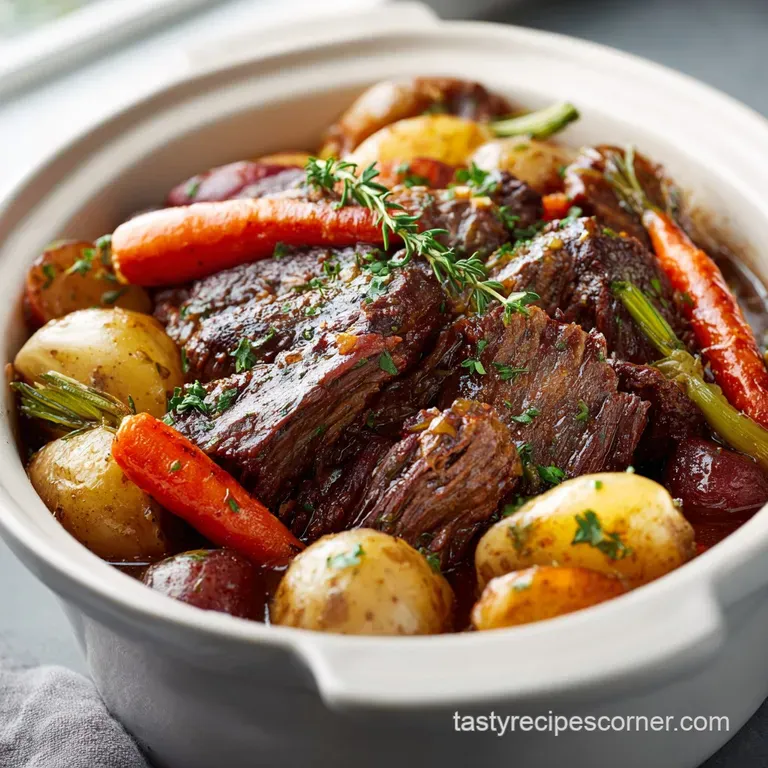
- Pat the 3.5 lb beef chuck roast bone dry with paper towels. Note: Moisture is the enemy of a good sear; dry meat browns, wet meat steams.
- Season the meat aggressively with 2 tsp kosher salt and 1 tsp coarse black pepper on all sides.
- Heat 2 tbsp avocado oil in a cast iron skillet over medium high heat.
- Sear the beef for 5–6 minutes per side until a deep mahogany colored crust forms.
- Layer the quartered yellow onion, 5 smashed garlic cloves, and 1 lb carrot chunks in the bottom of the slow cooker.
- Place the seared roast on top of the vegetables and tuck the 1.5 lbs halved Yukon Gold potatoes around the sides.
- Pour 1.5 cups beef bone broth, 2 tbsp Worcestershire sauce, and 1 tbsp balsamic vinegar over everything.
- Add the rosemary and thyme sprigs to the top, cover, and cook on Low for 8 hours until the meat is fork tender.
- Remove the meat and vegetables to a platter; whisk 2 tbsp cornstarch and 2 tbsp cold water together.
- Stir the slurry into the slow cooker and cook on High for 15 minutes until the gravy is thick and glossy.
Solving Common Slow Cooker Mistakes
Troubleshooting Common Issues
| Issue | Solution |
|---|---|
| Why Your Pot Roast is Tough | If you poke the meat after 8 hours and it feels rubbery or bounces back, it simply hasn't cooked long enough. Many people panic and think they've overcooked it, but with chuck roast, "tough" usually m |
| Why the Gravy is Bland | If your final sauce lacks punch, it's usually a salt or acid issue. Because the potatoes and carrots soak up so much seasoning, you often need a final "brightening" step. A tiny splash of extra balsam |
| Why the Vegetables are Mushy | This happens if you cut your carrots and potatoes too small. For an 8 hour braise, you need "peasant style" cuts big, chunky pieces. Halving the Yukon Golds and cutting carrots into 2 inch chunks ensu |
Scaling for Large Groups or Couples
When you need to scale this recipe down for two people, don't just cut everything in half and call it a day. If you use a 1.5 lb roast in a giant slow cooker, the liquid will shallow fry the meat rather than braising it. Use a smaller 3 quart slow cooker and reduce the cooking time by about 20%.
You'll still need roughly 6 hours to get the collagen to melt, but keep an eye on it.
For a massive crowd, doubling the recipe is straightforward but requires a bit of math. Use a 3.5 lb roast for every 7 people, but don't double the liquid 1:1. Only increase the beef bone broth by about 50% (to roughly 2.25 cups) because the meat will release a significant amount of its own juices.
You’ll likely need to sear the meat in batches, as crowding the skillet will cause the temperature to drop and the meat to boil in its own juices instead of developing that gorgeous crust.
| Servings | Meat Weight | Liquid Total | Cook Time (Low) |
|---|---|---|---|
| 3-4 People | 1.75 lbs | 1 cup | 6-7 hours |
| 7 People | 3.5 lbs | 1.5 cups | 8 hours |
| 14 People | 7 lbs (2 roasts) | 2.5 cups | 9-10 hours |
If you find yourself with extra beef but no veggies, you can always repurpose the meat into something entirely different. For example, the shredded beef works beautifully in a Beef Chili Verde if you want to switch up the flavor profile for the next day.
Creative Twists on Classic Roast Flavors
- The Mediterranean Twist: Replace the rosemary and thyme with dried oregano and a jar of drained pepperoncini peppers. The brine from the peppers acts as the acid, creating a "Mississippi style" roast with a Greek flair.
- The Pub Style: Swap half of the beef bone broth for a dark Guinness stout. The bitterness of the beer mimics the deep charred flavor of a grill and makes the gravy incredibly dark and rich.
- Healthy Low Sodium Version: Use a "no salt added" broth and double the garlic and balsamic vinegar. The extra aromatics and acid will trick your palate into not missing the extra sodium.
Proper Storage and Zero Waste Ideas
Storage Guidelines: This pot roast actually tastes better on day two. Store the meat and vegetables in the gravy in an airtight container in the fridge for up to 4 days. When reheating, do it slowly on the stovetop or in the microwave at 50% power to prevent the beef from becoming stringy.
For long term storage, this freezes beautifully. Put the shredded beef and gravy into freezer bags (remove as much air as possible) and freeze for up to 3 months. I don't recommend freezing the potatoes, as they can become grainy upon thawing.
Zero Waste Tips: Don't you dare throw away those carrot peels or onion ends! Toss them into a freezer bag. Once the bag is full, simmer those scraps with water for an hour to make a "scrap stock" for your next soup.
If you have leftover gravy but no meat, use it as a base for a quick beef barley soup or pour it over a pile of fries with some cheese curds for an impromptu poutine. The rosemary and thyme stems can even be tossed into the fireplace (if you have one) for a lovely, rustic kitchen scent.
The Best Southern Side Dish Pairings
While this recipe is a one pot wonder thanks to the 1.5 lbs Yukon Gold potatoes and 1 lb carrots, sometimes you want a little something extra on the side to mop up that mahogany gravy. In a true Tennessee kitchen, you can't serve pot roast without something bready.
Fluffy, buttery biscuits or a slice of sweet cornbread are the traditional choices. The way the cornmeal soaks up the savory beef bone broth is nothing short of a religious experience.
If you're looking for something a bit lighter to balance the richness of the 3.5 lb chuck roast, a crisp green salad with a sharp vinaigrette works wonders. Or, if you want to double down on the comfort, serve it alongside some Crock Pot Black Eyed Peas for a truly Southern feast. The smokiness of the peas complements the deep, seared flavors of the roast perfectly. No matter what you choose, just make sure there's enough of that thickened gravy to go around it's the real star of the show.
Southern Kitchen Myths
Myth: Searing "seals in" the juices. This is one of the oldest lies in the book. Searing actually causes the meat to lose a tiny bit of moisture due to the high heat. However, we do it for the "Maillard reaction" that chemical process that creates hundreds of new flavor compounds.
We aren't sealing anything; we are building a flavor profile that no amount of slow cooking can replicate on its own.
Myth: You must cover the meat in liquid. If you submerge the roast completely, you are boiling it, not braising it. Braising is a combination of steam and simmering.
By using only 1.5 cups of broth, we allow the top of the roast to be surrounded by flavored steam, which keeps the texture of the meat intact while the bottom simmers in the concentrated juices. This results in a much more intense beef flavor.
Myth: High heat is just as good as Low heat. While most slow cookers reach the same final temperature on both settings, the "High" setting gets there much faster. This rapid rise in temperature causes the muscle fibers to contract violently, squeezing out moisture before the collagen has a chance to melt.
By choosing the 8 hour Low setting, we give the meat a gentle "ramp up," allowing the fat to render and the fibers to stay relaxed. Trust the process; the wait is worth it.
Recipe FAQs
Is it true I must brown the beef before slow cooking?
Yes, searing is essential for flavor. Searing the beef in avocado oil for 5 6 minutes per side creates a deep mahogany crust that develops the base flavor profile of your final gravy.
Why is my pot roast still tough after cooking?
No, this is a common misconception that the meat is overcooked. If the roast feels rubbery after 8 hours on Low, it simply needs more time for the collagen to render. Continue cooking until the meat fibers pull apart easily with a fork.
How to prevent the vegetables from turning into mush?
Cut your carrots and potatoes into uniform, large 2 inch chunks. Keeping the vegetable pieces substantial ensures they maintain their structure during the long 8-hour braise.
How to thicken the gravy at the end?
Whisk 2 tablespoons of cornstarch with 2 tablespoons of cold water into a smooth slurry. Stir this mixture into the hot crockpot juices and cook on High for 15 minutes to reach the perfect consistency. If you enjoyed the thickening logic used here, see how we apply the same science to our beef Texas chili for a hearty texture.
Can I use different vegetables like celery or parsnips?
No, stick to the provided ingredient list. This recipe is specifically balanced for Yukon Gold potatoes, carrots, and onions to ensure the cooking times and moisture release remain consistent.
How to tell if the roast is fully cooked?
Check for fork tenderness. The meat is perfectly finished when you can easily shred it with a fork; if it provides resistance, allow it to continue cooking on Low.
How to store leftovers properly?
Place the cooled meat and vegetables in an airtight container in the refrigerator. It will stay fresh for up to three days, and the flavors often improve as they meld overnight.
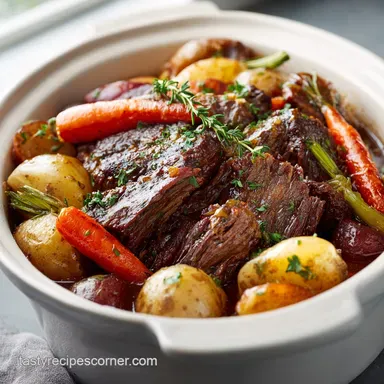
Slow Cooker Pot Roast
Ingredients:
Instructions:
Nutrition Facts:
| Calories | 568 kcal |
|---|---|
| Protein | 41g |
| Fat | 34g |
| Carbs | 26g |
| Fiber | 4g |
| Sugar | 5g |
| Sodium | 685mg |
